Showing posts with label 1900. Show all posts

Sunday, July 1, 2012

Powder Blue Parasol, Part 2 (the last)

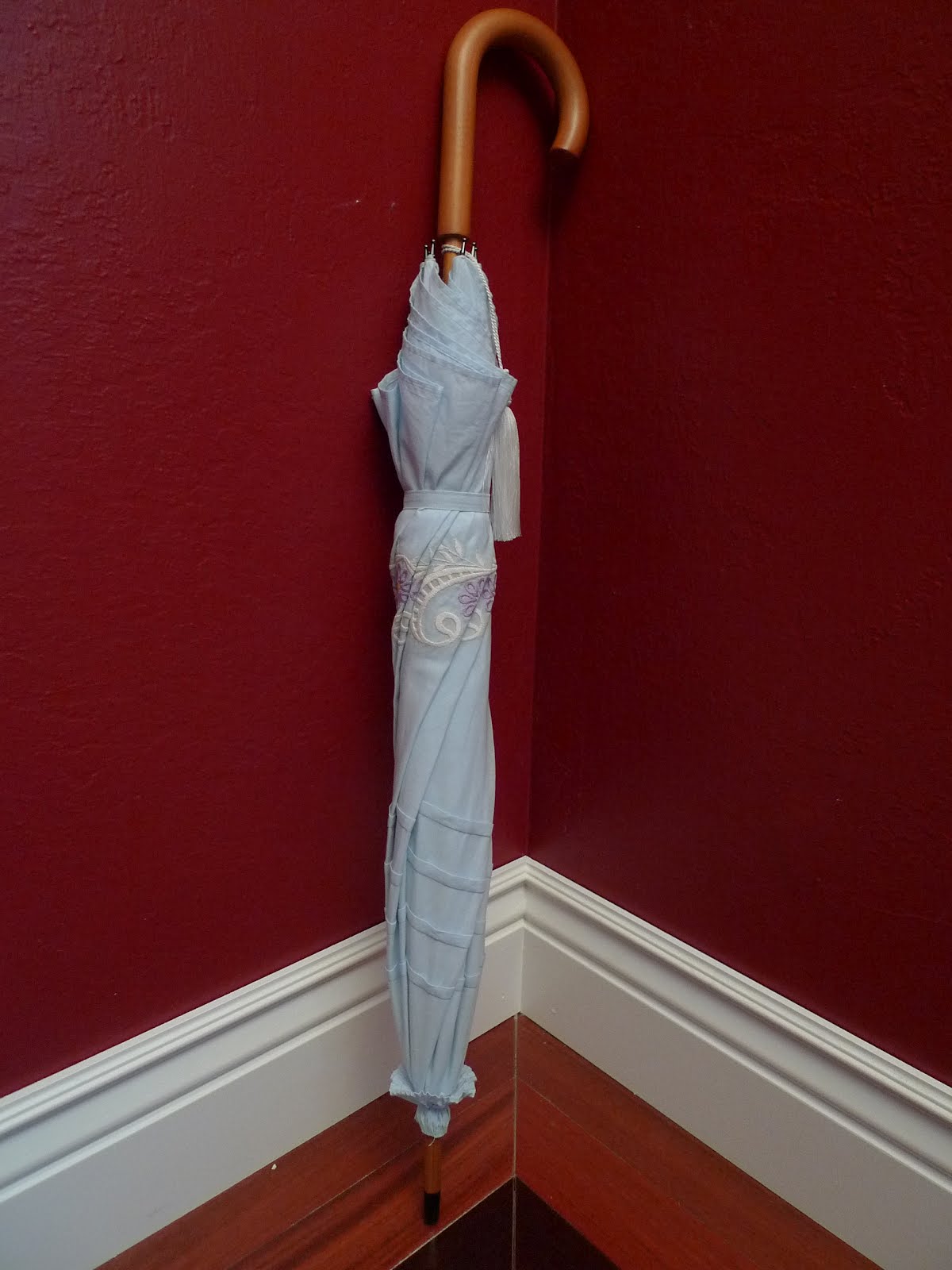
I finished the powder blue cotton parasol that I was embroidering in this earlier post. This parasol was the finished sample for my class last week, though it wasn't really done until I picked up the tassel from Lynn McMasters at the class. Here's the full photo spread I took after the class.

The finished parasol.
The large canopy panels gave me lots of room
to embellish, first with some simple embroidery.
In the upper area I put four rows of tucks.
A small rosette covers the opening in the
center of the canopy..
Small touches make this modern frame
look more period, like these rosettes
on the underside of the canopy.
A full view of the underside.
Another finishing touch, a custom-made tassel
by Lynn McMasters.
Lynn is teaching a class on tassel making at Costume College. She and I have been lamenting how modern tassels and fringe just don't look like the silk tassels and fringe of 100 years ago. She's been developing tassels. I've been developing fringe. But more on that later.

This parasol uses a ring-and-button closure mechanism I've
seen on extant parasols.
And propped in a corner.
For your amusement, here's the reverse sequence of how this parasol came from a modern umbrella.


Sunday, June 24, 2012

Edwardian Parasol Workshop

What a fun day! Yesterday I taught a class for the Greater Bay Area Costumer's Guild, "Edwardian Parasol Recovering Workshop." I had eleven enthusiastic, talented, and creative students. No one finished, but just about everyone just had to do the final attaching-to-the-frame.

This was the first class I've ever taught for the GBACG (I've taught privately and at Costume College). I do wish everyone had been able to finish, and have some ideas for next time. Yes, there will be a next time, I had a ton of fun and would do it again!

Here's a photo recap of the day (scroll to the end to see some of the results!)

Umbrellas packed, student packets packed.
Parasols packed!
A handful of antiques from my collection. I brought them to
give a lecture on history and mechanics of parasols.
Some more antiques and two modern, recovered parasols.
AJ de-nuding her umbrella, with Tara and Leah.
Chris and Lynn stitching away.
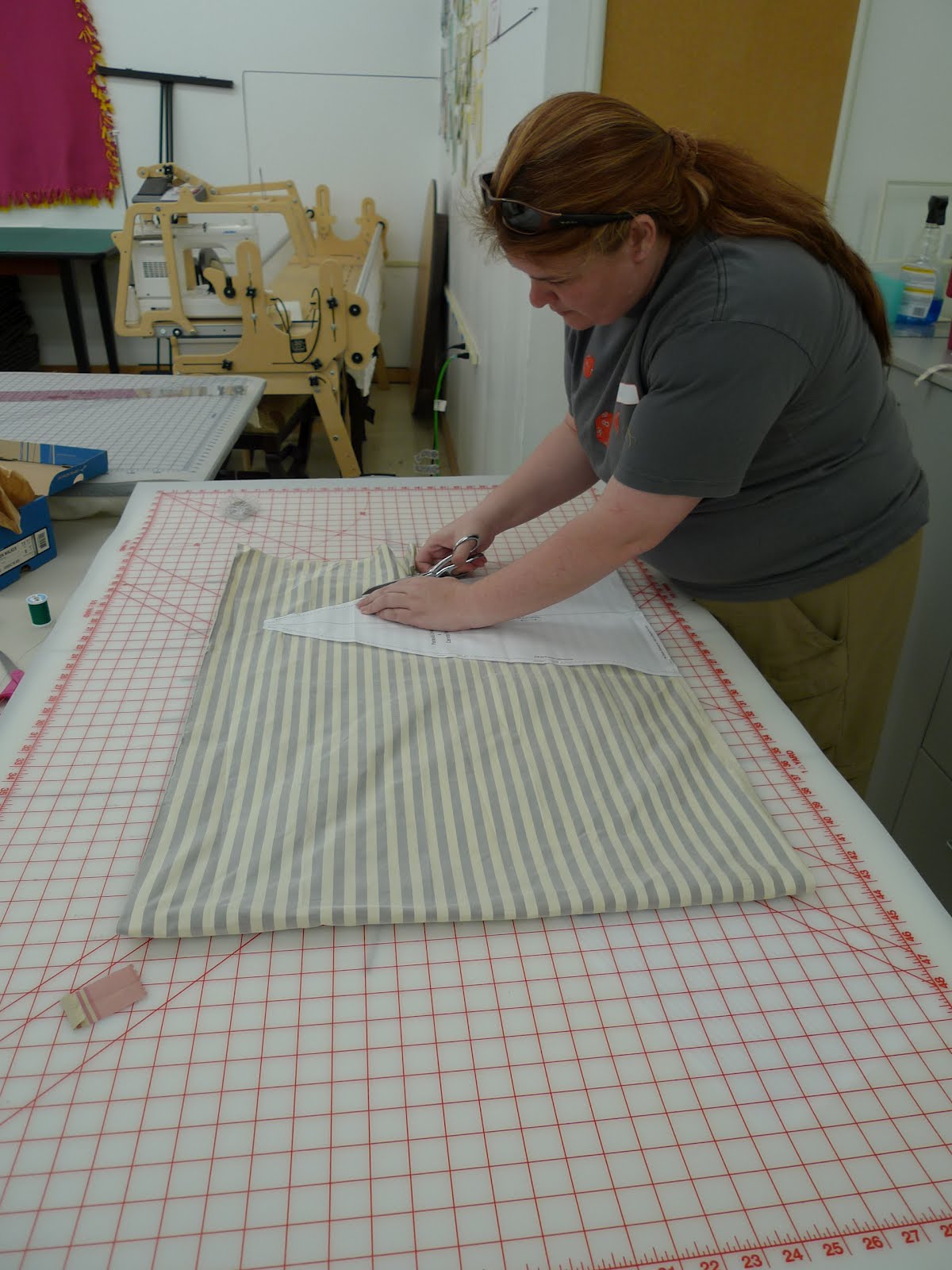
Noelle, cutting deliciously striped silk.
Tara and Judith, who is deeply
contemplating her trims.
Lynn made her two smocking pleaters available for the
class (this one has been at my house for a few
weeks...I've had MUCH FUN with it).
We used them to gather up the rosettes.

And here are some of the results!!!

Judy's stripes.
Judy made her outside rosette extra long. Love it!
Anne's plaid.
Plaids just do GREAT on parasols.
Lynn's, with pinned on gimp
(there will also be FRINGE!)
Great deep dome.
Leah's cotton stripes. You can
run your stripes around, or up and down!
Manon's sea foam blue silk.
Tara's printed silk.
When we stepped outside, it positively
GLOWED.
I'll have follow-up posts for the two frames I prepared as demo's for this workshop, and then maybe I'll, like, stop talking about parasols for a little while. Maybe. ;)

Wednesday, June 6, 2012

Powder Blue Parasol, Part 1

I've been embroidering again. This design is for the parasol I mocked up in this earlier post. One of two, actually, since I'm going to do two versions of this parasol.

Oh right: that's what the umbrellas are all about. The frames are pretty darn good for converting into Edwardian-era parasols.


This design actually has a cutwork component, but I've enlarged it so much that I don't trust the cutwork area (the wedge shapes) to be stable.

Here are all the panels, stacked up and ready to sew...but that'll have to wait for later.


I'm following the philosophy of: if you can find  half hour to do a little sewing (or blogging!) DO.

Monday, May 28, 2012

So, about those umbrellas....

Getting back to those umbrellas: here's one. It's flat, black, boring and very umbrella-like.

"Rainkist" branded umbrella. Sold to me as a
"Leighton Fashion Stick" No idea if they're
the same, but it doesn't matter, the umbrella
I got had these essential features:
manual open, a wooden stick and handle,
and sew-able rib tips. The slider is still
plastic, but I can live with that.
The ribs on this umbrella are quite long, and have some room to flex. So, after a little manipulation of the original canopy, we have this:

Same umbrella, after manipulating the canopy with some pins.
Here's what the result after drawing a new pattern and mocking it up:

Mock-up of the redrafted canopy.
Are we looking more Edwardian-ish yet?

Tuesday, May 15, 2012

Why does she have so many umbrellas?

I'm almost back! As you can see from the gaps in my posts, I have to take long hiatuses every so often. It's painful to be away from costuming so long, but at least it's temporary.

I'm not quite free to come back yet, but I had a delivery yesterday so I thought I'd post a preview of what's coming up.


Yup, that's over a dozen umbrellas. More to come soon.

Saturday, November 5, 2011

Restored Parasol, c. 1900

There's nothing like a deadline to get you hopping on a project, right??


I needed a parasol for an outdoor event today...then, of course, today was completely overcast and verging on RAIN, so the parasol stayed home. Poo. Ah well, at least the parasol is now DONE.


This parasol's canopy was originally the subject of this earlier post I wrote, outlining the process of doing a large machine embroidery. The base fabric is medium weight linen, and the embroidery is cotton quilting thread on top, polyester sewing thread underneath.


I bought the frame a number of years ago, and it came to me completely bare, except for the  disintegrating remnants of silk wrapping that padded the spreader joints. These I removed and replaced with scraps of linen from the canopy. The frame also had rust around the top, and a little at the rib tips, which I painted over, partly for aesthetic reasons and partly to avoid the rust from spreading. The handle is some mystery wood and the shaft is a single piece of bamboo.

Since I was in a rush, I was just going to finish attaching the canopy and use the parasol. Buuut I couldn't leave well enough alone, so I also finished the "rosette" above the slider, and the "scrunchie" around the finial (I've made up those terms; I don't really know what they would've been called for real).


In reality, the most challenging part of restoring this parasol was that it was missing the cap that parasols often (but not always) have at the top of the finial. I sacrificed a slightly expensive (but real metal) pen to make this final cap. I'd like to find a better solution, but for now, this will do.


The parasol's handle didn't need any work. I cleaned it, back when I bought the parasol, with some wood furniture cleaner, but have otherwise left it alone.


So what's with the date of this parasol? It's really challenging to pin a parasol to a precise year, let alone an exact decade. There are a number of factors that one can use to establish a date (such as the rib construction, the style of spanner joints, the overall length, and the size and shape of the canopy), but when it comes down to it, there was never only one style of parasol in existence in any given year. Sure, there may have been a general look that was in fashion, but within that look there would have been plenty of room for variation, and who's to say that someone didn't offer styles that were just not in fashion It's not like the 1890s or 1910s had only ONE style of shoe. We know that just wasn't true.

Anyway! By my estimation, this parasol might have been built anywhere from 1890 to 1910, so I've labeled it with a date smack in the middle.

Lastly: what have I learned from restoring this parasol? First: the canopy is heavy. All the surviving canopies I've seen that aren't silk or lace have been fine, light cotton. Next time I do a canopy like this, I'll use cotton instead. Second: the "skirt" around the edge of the canopy doesn't really work. It tends to flip up when I open the parasol. I honestly don't think I've seen a skirt like this on a surviving canopy; skirts tend to be cut in crescents that leave the rib tips exposed. Now I think I know why!