Showing posts with label corsets. Show all posts

Thursday, July 21, 2011

What's Underneath: Half-Boned Stays c. 1760

The last layer underneath my 1750 Court Gown is a set of stays (more photos here):


Yes, I KNOW the lowest layer should be a shift...I don't have one...it's on the list...I'll get to it eventually!!!

Front laced stays are not common, but not unheard of. My old stays lace in back only, and are fully boned, so this was an attempt to do something completely different. Front lacing really does make putting this on super easy.

I started with the Butterick pattern, 4254, because the shape of the pieces are, essentially, documentable. I suspect this pattern is based on an illustration in Norah Waugh's Corsets & Crinolines but I don't have the book handy, and can't check.

Aside from the the approximate correct shape of the pattern pieces, the pattern was BAD. It had the typical "Big 3" problem, in that for my measurements it expects to be worn with back edges touching. The bigger problem, though, was that it's extremely short. My body runs a tiny bit short from bust to waist to hip, and it was waaay to short for me. I started with one size smaller than the pattern recommended, added length, removed tabs, moved the shoulder tabs...it's not really the same pattern anymore. I went through three mockups (and one expert fitting consultation) before I was satisfied.


It's made of two layers of linen canvas, heavily starched, and one layer of what I think is an upholstery linen (it's quite thick ).To get the look of hand-stitched channels, I used a heavy linen thread on the exterior (35/2 from Burnley and Trowbridge), lighter cotton thread for the bobbin. I used the same heavy linen thread for the eyelets.The boning is "artificial whalebone" (aka German Plastic).


The binding is natural pigskin.

Since I'm teaching a class on lucet weaving at Costume College this year, I felt I had to put rubber to the road, so the speak. So, the straps and front of the stays are laced with standard lucet cord, made from cotton crochet cord, and the back is laced with double lucet cord. I think the cord is certainly sturdy enough for this application...I just need to get all the stretch out.


I feel like I've been making these stays for 10 years...that's when I bought the tomato red linen that makes up the exterior. They have, of course, evolved in those years (for instance, I had originally planned to hand stitch the whole thing, and Butterick 4254 didn't even exist back then) and despite making the first mock-up two years ago, it took me until March of this year to actually CUT the red linen. Costumer's sewing block? Nah, I've just had so many other things to do, and have a great set of stays already...but the old stays has issues...hence, new stays!

Thursday, July 7, 2011

Cap c. 1760 and Bed Ticking Stays, c. 1715

These things are really rather old, but they're new now because I just uploaded galleries to my sad little website (it needs a lot of work...I'll get to it, eventually!)

First is a mid-1700s cap, which I think I finished in late 2007 or early 2008 (full gallery is here):


I love caps. They're one of those things that really make a costume complete. I made one cap before this, but gave it to a friend without taking pics.

The pattern is from La Fleur De Lyse. The drafter, Suzanne Gousse, dates her caps to the mid-eighteenth century, so I've arbitrarily slapped the date 1760 on this cap. It's made of cotton organdy, which can hold those pleats without pressing! Amazing stuff. The tape is linen.

I forgot to take a pic of the cheat I use to keep it on my head. Soon as I remember, I'll add that.

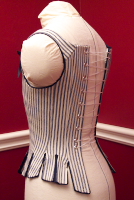
Next is a set of stays from around 1715, which I think I made in 2005 (full gallery, with a ton of pics, is here):


Yes, they are made from bed ticking. The interior is muslin, the boning is "artificial whalebone" (a.k.a. German plastic), the binding is poly grosgrain and the grommets (gasp! yeah, I was in a hurry) are nickel.

Here are the slightly edited notes I wrote up on my website:

These were my very first set of stays. At the time, I just really needed something, and fast, so that I would have a foundation to make gowns over. Hence, I made no effort to use period-accurate materials, and used whatever I could get from the local fabric store (except the grommets and plastic whalebone, which I already had).

For the pattern I used the Custom Corset Pattern Generator as the base, and modified the result using an illustration from Cut of Women's Clothes by Norah Waugh. Waugh apparently based this illustration on one in Maurice Leloir's Histoire du Costume. Interestingly, Leloir dates these stays to 1715, while Waugh dates them to the mid-eighteenth century. Since Leloir came before Waugh, I'm un-scientifically going with his date.

In constructing these stays, I used what I read to be a historically accurate method: make up each of the ten panels individually (sew channels; insert boning), attach the panels to each other, then bind the edges. The stays should probably have a lining, but I didn't bother.

I never used these stays. They have two problems: first, the center front point bends up, though that can easily be fixed by adding a busk pocket and busk to the inside. The second problem is harder to fix, which is that the straps are set too close to center front. While this doesn't affect the fit, the wide, deep necklines that are common with 18th century clothes mean the straps would show.

But probably what really happened with these stays is that I made the set that I actually use, and moved on without them.