Showing posts with label yarn-crafts. Show all posts

Friday, November 12, 2021

Stitch Markers for Tunisian Crochet

In knitting, stitch markers are used to keep track of key points in the work, such as where to place increases or decreases, the starts and ends of stitch patterns, or just to break up a long row of stitches into smaller block so that the stitches are easier to count. Knitting patterns will have instructions such as "place marker (PM)" or "slip marker (SM)" that should help you check that your work is in line with where you are in the pattern.

I've done a little bit of Tunisian crochet (also called Afghan crochet), and in the couple of patterns for shaped garments that I've looked at I didn't see use of stitch markers. Likely this is because knit-type stitch markers, which are typically rings of some kind that you thread onto your needles, don't work in crochet. Tunisian crochet patterns seem to solve the lack of stitch markers by providing stitch counts. All well and good if you're working narrow pieces without increases or decreases, but once the piece is wider and maybe a bit more complicated? You spend a lot of time counting, losing track of the count, starting over counting, etc. Moreover, the written pattern can get very long and tough, or even tedious, to read.

Now, I don't do a lot of crochet, but I do like to make amigurumi animals from time to time, and from one pattern I learned about using scrap yarn to mark the beginning of each row. You can see example of using scrap yarn as a stitch marker here.

Stitches n Scraps does a fine job of explaining how to use scrap yarn for stitch markers, but I'm going to provide my own tutorial as applied more specifically to Tunisian crochet. I hope that Tunisian designers will adopt the use of stitch markers, and start writing more concise, easier to follow patterns.

Step 1:


I've cast on 16 stitches, and will use a marker to indicate the middle of this piece. I cut a piece of scrap yarn about 4" long. It's best to use a really smooth yarn, like cotton, and to stay away from a really grabby yarn, like wool.

Step 2:


Using a yarn needle or small crochet hook, pull the scrap yarn between the stitches where you want the marker to be.

You can also lay the scrap yarn in place when picking up the stitches, and I would if I'm casting on a lot of stitches and am using stitch markers to count them. I find picking up the first row a bit fiddly, though, so like to add the stitch marker after the stitches are on the hook.

Step 3:


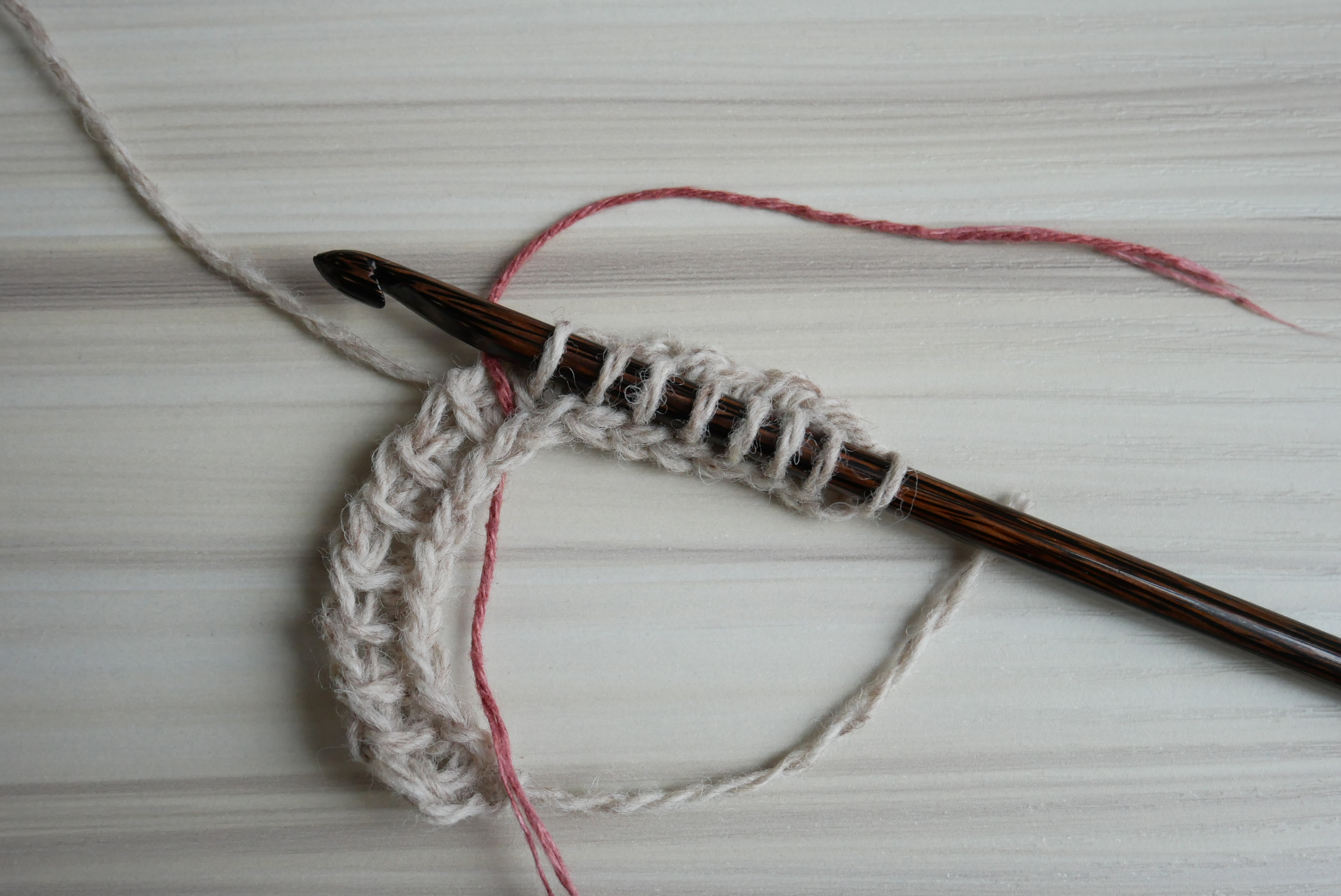
Work the first reverse pass. The scrap yarn should be hanging out between two loops.

Step 4:


Work the next forward pass (note that I'm doing Tunisian Knit Stitch (TKS) in this example). Once you've picked up the loop that is one stitch before the stitch marker, flip the scrap yarn over to the back of the work. Make sure your working yarn is on your left (or right, if you're working left-handed) to avoid the scrap yarn getting wrapped around the yarn in the back.


Finish the forward pass, work a reverse pass.


This is what the work looks like after the reverse pass.

Step 5:


Work the next forward pass. Once you've picked up the loop before the stitch marker, flip the end of the yarn from the back of the work to the front of the work. Again, make sure the working yarn is on the left before you flip the scrap yarn.

It's OK if the scrap yarn gets caught under the bit of yarn that sits between stitches, but the scrap yarn gets harder to pull out.

Complete the forward pass and work a reverse pass.


Continue flipping the scrap yarn from front to back or back to front on each forward pass (sometimes I flip the yarn only every other row).


After you've done a number of rows, you should have what looks like sewn stitches between two columns of the work.

Once the scrap yarn starts to become too short to flip to over the work, pull it until you have enough to flip. This is why the scrap yarn needs to be smooth: it's going to get dragged through your work as you go along. Be careful to not pull so hard that you pull the scrap yarn completely out.

I hope you will find these instructions helpful, and I encourage all Tunisian crochetters out there to use stitch markers everywhere and anywhere!

Monday, October 17, 2016

A short post about weaving

Geeze, it's been over a year since I've posted anything.

So why am I here now? Well, a recent visitor to this blog had a question about weaving, which it so happens I have been doing lately. Some time back I acquired a Schacht Rigid Heddle loom (this one though without the stand). I've done some rigid heddle weaving with a paddle loom, and also a little bit of card weaving (which is totally fun and I need to do it again), and at one point I had some ambitious weaving ideas, including crazy long shawls seen in Regency fashion plates, and period accurate fringe (eventually, one of these ideas will come to fruition...)

Anyway, I wanted to be able to do more weaving than I could do with the paddle or the cards, but wasn't about the shell out big bucks for a floor loom. So, I went with a table loom with two rigid heddles.

My first weaving project was pretty much a total failure, due to poor yarn choice. Maybe fuzzy angora-style yarns can be woven, but THIS particular fuzzy angora-style yarn SUCKED. I gave up on the weaving after only a few inches


For my second weaving project, I used what I think is a cotton or cotton-blend yarn.


Yeah, that's me sitting on the floor with the loom, which is not how it's supposed to be used, and is not good for my back. Ahem.

Here's the scarf that I wove.

The yarn was slightly variegated, which serendipitously resulted in a plaid pattern.

 
This scarf was for the charity knitting (to which I've added weaving) a group of us at my work have been doing. This one will join the Red Scarf Project donations.

Wednesday, August 20, 2014

The Thrifty Woman's Yarn Workshop

A handful of folks saw me at Costume College plying yarn with my homemade drop spindle.
A drop spindle made from things you can find around the house (well, my house, anyway).
Now, I have a very nice, wooden drop spindle, but it has yarn on it that I don't want to take off yet. So I needed second spindle. I made one using these instructions, though I didn't want to hunt for the plastic grommet, so I hot glued the disks in place (I glued one disc on at a time, letting the glue cool a little first, and spun the dowel while the glue was cooling, to keep the dowel centered and the glue even).

Once I plied all the yarn, I needed to get it off the spindle so that it could get a quick wash to set the twist. I don't know if this next tool has a name; it's a box with holes and slots cut in to hold the spindle while I pulled the yarn off.

Spindle holder? Spool winder? Spinny thing? I don't know what to call this box-with-holes cut in.
Lastly, here's my...well, let's be honest, this is the GHETTO-est yarn swift ever. It's a box on a small lazy susan. 

The ghetto-est yarn swift ever.
Oh wait, one more tool was involved. I don't have a yarn winder, so I hand wind on a nostepinne. Except that I don't have a nostepinne, I use a clean chopstick.
My "winding stick" (a chopstick).
I'll show you later what I actually made from this yarn (which I was also carrying around with me at Costume College).

Now, for the yarnies that are still with me, here's a treat: I was at the Whaling Museum in Nantucket just recently, and found these beautiful, whalebone yarn swifts.

Whalebone yarn swift at the Whaling Museum in Nantucket.
It's such a delicate thing, can you imagine it being actually used to wind yarn? Moreover, can you imagine the labor to make this thing (each strut is ornamented) and the feelings of the woman who would have received it? She had better have been gratified.

The museum had a couple of whalebone swifts.

Whalebone objects at the Whaling Museum in Nantucket.
These were displayed with several whalebone knitting needles, sewing clamps, and some other objects that I didn't take note of. These objects are made from bone and not baleen, which is the "whalebone" used for corsetry. I saw some samples of unprocessed baleen, but didn't get a photo.

And of course, one can't discuss objects made from whalebone without mentioning BUSKS.

Whalebone busks. The darker one might be baleen, I didn't read the label.
The museum has managed to get a hold of quite a few beautifully carved busks.
The Whaling Museum is very nicely done. A lot of time (and money, probably) has gone into the displays, and there are some very nice talks (though skip the movie, it's heavy on "isn't this island great" and way to light on history and facts; the presentation on the history of whaling was VERY good, however). If you happen to be on Nantucket Island, I recommend a visit.

Friday, May 24, 2013

The Last Eight Months Have Not Been Idle

I know it's been more than eight months since I posted last, but it's been at least that long since I've posted about anything I've been doing. Those of you who know me in real life know that I have had a LOT going on, none of which has to do with costuming or crafting. In theory, most of that will wrap up at the end of summer and leave me with more time to sew, but, well, you know...we'll see. :)

Anyway, even when I have too much piled on I make time to craft, if for no other reason than to maintain my sanity (such as it is). I just kept the projects bite-sized and portable. That is, I took up knitting and crocheting.

At Costume College last August, I took a one-hour course on Tunisian crochet. I had learned to crochet and knit when I was really young, but stopped around the age of 18, sever, er, decades ago. I had never heard of Tunisian crochet, so I thought I'd give it a go. Well, that lead me to starting to crochet again, whiiich lead inevitably to my knitting again.

Little bit of a Tunisian crochet sampler scarf I started. This is some sort of wrapped stitch that I got out of the book 101 Easy Tunisian Crochet Stitches.
So here's a sample of the things I've knit, in no particular order. Nothing historic, just stuff I can wear every day, with a sprinkling of totally random nonsense.

Crocheted flying piggy.
Tunisian crocheted moss green cowl.
Storage tube for my crochet hooks (an experiment in Tunisian  crochet stitches and crocheting in-the-round).
Tunisian crochet fingerless mitts, also made in-the-round.
Matching neck warmer, also in Tunisian crochet.
Crochet sweater-coat (really more coat than sweater).
Knit shrug, made from cashmere yarn recycled from a store-bought shrug.
And finally, a sad little crochet bear.
If you find my yarn-work interesting (or you're just a yarn addict), and you're a Ravelry user, come find me over there, my username is "cdemontigny".

More to come soon! I've got more costuming and crafting goings-on to report. Stay tuned!